By Q9 Labs
One profile for every applicant, built from evidence
Q9 Admissions gives an admissions committee an adaptive test, a live AI interview and integrity checks, combined into one profile per applicant, with the applicant's own words as proof.
- 1Applicant takes the adaptive test
- 2Nura interviews them
- 3The browser records integrity evidence
- 4The committee gets one profile
What it does
Adaptive test
Ten questions in English, quantitative and science reasoning. Each answer sets the difficulty of the next, and questions are written afresh for each applicant, so a shared answer key helps less. A reviewed question library takes over if writing one fails. The result is a band with a stated confidence.
AI interview
Nura, a voice interviewer, holds a six-minute conversation in English and follows the institution's own interview criteria. It asks one follow-up for a specific example and never tells the applicant how they did.
Integrity checks
A camera check before the test, then a record of what the browser saw: window changes, fullscreen exits and paste attempts, each with a picture. It is evidence for the committee to weigh, never an automatic fail.
The committee profile
Applicants are ranked on one combined score. Open one and the committee sees the test band and how it was reached, the interview scored on each criterion with a quote as evidence, the full transcript, and the integrity record, side by side.
Each institution gets its own profile: name and logo, programmes, interview criteria and the test's skill areas. Khalifa University is the first, and it is the sample shown here.
Open the sample committee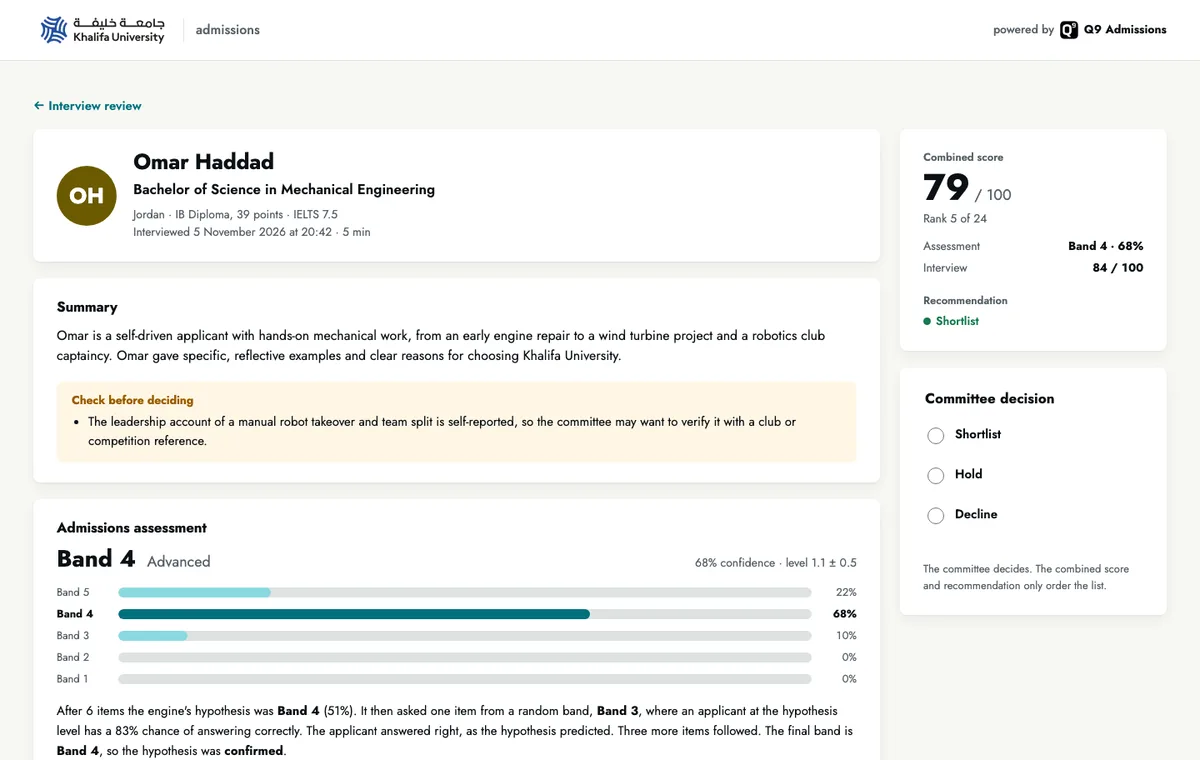
What this does not claim
- The five difficulty bands are set by how each question was written. They are not yet calibrated on real applicants, and a pilot does that first.
- The test has ten questions, which is standard for an adaptive test. We do not claim it needs fewer.
- A website cannot lock a computer the way an installed lockdown app can. The integrity record is what a browser can see, and a desktop app is a later phase.
- The committee decides. The profile ranks and explains, and a weak test band can hold a recommendation back but never raises one.
- This demo uses fictional applicants and illustrated camera pictures. It has not been tried with a human voice at scale.
See it as an applicant
It takes about fifteen minutes and needs a microphone. The camera is optional.
Try the demo